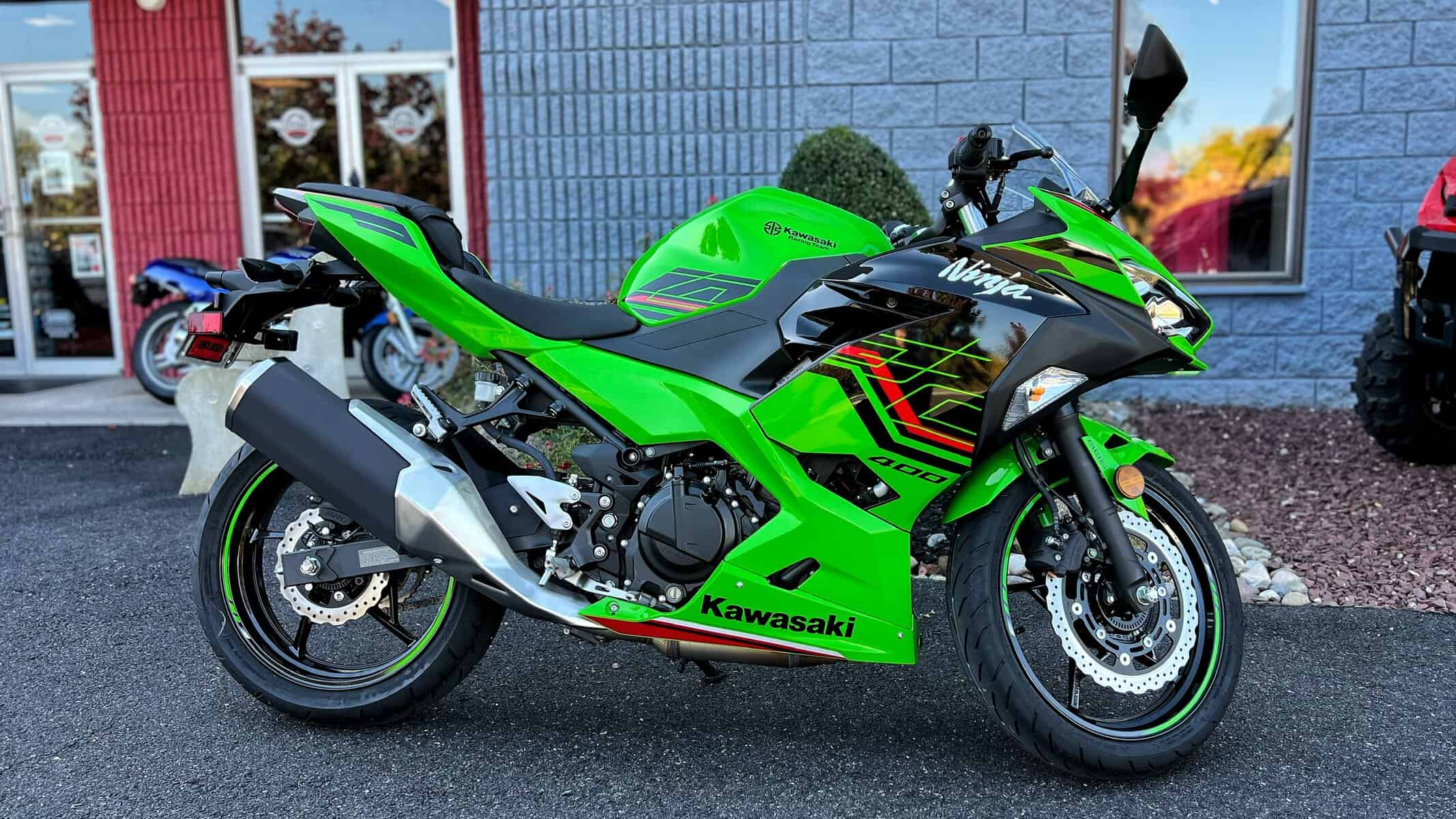
I picked up my 2023 Kawasaki Ninja 400 in October of 2022 and by the time I hit about 1,100 miles I had enough seat time to have some real opinions about it. This is my Ninja 400 1000 mile review, and I want to be straight with you: this is early ownership stuff. I’ve got a long-term review coming down the road, but right now I want to talk about what the first stretch of miles has been like.
Why I Bought a 400
My primary bike is a 2022 Yamaha MT-09, which I absolutely love. But when I’m on twisty Pennsylvania back roads at lower speeds, that bike can be a bit overkill. It’s got way more power than the road needs, and sometimes that works against you. I wanted something smaller and more dialed in for that kind of riding.
I was also a little on the fence about the format. I’m 40 years old and I’m not doing the full race replica thing anymore. A tucked-in, aggressive sport bike just wasn’t going to work for me. But when I test rode the Ninja 400, I was surprised by how comfortable it felt for a sport bike. Kawasaki has clearly moved in the direction of street-friendly ergonomics rather than building something track-ready, and for what I wanted to do with it, that was exactly right.
So I bought it. And yeah, I still get the occasional raised eyebrow when people find out I went from an MT-09 to also owning a 400. The conversation usually goes: “Oh, so you started on the 400 and moved up to the MT?” Nope. Bought the MT first. Bought the 400 because I wanted something fun and nimble for the back roads. There is no shame in that, and I’ll come back to that point a little later.
How It Actually Rides
Comfort
I’m five foot nine with a 30-inch inseam and I can flat foot the Ninja 400 without any trouble. The foot peg position is sport bike territory so there is a bend at the hip, but it’s not aggressive enough to cause any real discomfort. I can ride this thing for well over an hour and not feel beat up.
The clip-on handlebars have a slight riser built in which brings the bar position up and toward you enough that you’re not really feeling like you’re pitched forward. It’s a comfortable riding position for a bike that still looks like a sport bike.
Power and Gearing
The power delivery is exactly what you’d expect from a 400. It’s not loaded with grunt and you have to stretch the gears out to get moving. The gear ratios are short so you’re shifting a lot, and honestly that’s part of what makes this bike fun on the kind of roads I ride. You’re down shifting into a corner, powering back out. You’re engaged. It’s not like a big CC bike where you can park it in second gear and cruise at 55 mph all day. You actually have to work the gearbox and that keeps things interesting.
It’s also a good bike to sharpen your skills on. I had a chance to borrow a friend’s wife’s Honda CBR300R for a group ride when my MT-09 was down for repairs and that experience stuck with me. On the 300 you had to be in the right RPM range or the bike wasn’t going to pull the way you needed it to on a twisty road. There was no torque reserve bailing you out if you were lazy with your shifts. I rode better that day because I had to. The 400 has a similar effect.
Tech (or the Lack of It)
I’m going to say this plainly: if you want the latest tech, look elsewhere. The Ninja 400 is bare bones. It has ABS front and rear and that’s about where the feature list ends. No ride-by-wire throttle, no ride modes, no traction control, no IMU. It’s a base model motorcycle in every sense.
For what it is and who it’s for, I think that’s fine. The ABS does the job it needs to do and the bike comes in at just under six thousand dollars for the KRT Edition. If you want all the electronic assists, bump up into the middleweight class and look at the 650 and 660 range.
Fuel Economy
Fuel consumption on this little bike is genuinely impressive. There’s a small triangle light on the dash that illuminates when you’re riding efficiently and when that’s on I’ve seen anywhere from 75 to 90 miles per gallon in real time. On average, riding the way I typically ride, I’m probably sitting somewhere between 50 and 60 MPG depending on how hard I’m pushing it.
I’ll be honest, I’ve never actually run the tank down to the fuel light because every time I stop for gas with a group I top off. I might only put a gallon in the thing. So I couldn’t tell you exactly how far it’ll go on a full tank, but I can tell you I’m not thinking about fuel on short to medium rides the way I do with the MT-09.
The First Service and a Broken Piece of Plastic
The Ninja 400’s first service interval is at 600 miles, though I actually rolled in to Martin Moto in Boyertown at 764 miles. I like to do things by the book while the factory warranty is in play. The last thing I want is to have a warranty debate and have someone say I didn’t properly maintain the bike. The service came out to about $165, which was primarily labor for an oil change plus the consumable materials.
The second thing I needed to deal with at that visit was a broken body panel.
I was out riding with a buddy, we stopped for gas, and when I was getting off the bike I caught a piece of rear plastic with my knee and snapped it clean off. It bounced off the ground and I just stood there staring at it. The bike was three months old and I had already broken something.
I reached out to Kawasaki first, figuring worst case they’d say no. They told me to take it to a dealer to be assessed, which felt like getting the runaround at the time. I brought it to Martin Moto, explained the situation, and the service manager told me that body panels are normally considered damage and aren’t covered under warranty. But then he told me about Kawasaki’s good faith warranty program, where if a repair comes in under a certain dollar amount they’ll cover it to keep customers happy.
He pulled up the part, confirmed it would come in under the threshold, and said he’d get it submitted. A few days later the replacement panel and decal arrived and I was back on the road. Kawasaki handled it without any hassle and the dealership went to bat for me. I was genuinely impressed.
A Few Gripes Worth Mentioning
No bike is perfect and the Ninja 400 has a couple of things that get under my skin a little.
The exhaust is huge. Kawasaki clearly engineered it for noise compliance and it does its job, but there’s not a lot of space between the foot peg and the heat shield. I find myself bumping that heat shield with my heel when I’m moving around on the bike trying to get settled. It doesn’t affect anything functionally, it’s just annoying.
The mirrors are also positioned pretty far out on the front of the bike. From a riding position I have to reach to adjust them and they make everything behind me look a lot farther away than it actually is.
Neither of these is a dealbreaker but they’re worth knowing about.
On Small Displacement and What People Think About It
I want to talk about something that came up after I posted early videos about this bike. The reaction I kept getting was some version of: “Great bike for a beginner until they’re ready to move up.” And I get why people think that. But I don’t think the Ninja 400 is strictly a beginner bike and I don’t think there’s anything wrong with experienced riders choosing to own one.
In the US we have this thing where a 300 or a 400 is considered small displacement and there’s almost a stigma attached to it. In Europe and Asia people ride 50 to 125cc bikes as legitimate transportation. Only here does a 300 get the “only” treatment. Only a 300. Only a 400.
Ride your ride. If it’s your first bike, enjoy it, learn it, take an intermediate course through Total Control or another good training provider, and get everything you can out of it. If you’re an experienced rider and you want something small and fun for back road riding, nobody should be giving you grief about that. I own an MT-09 and I chose to also buy a 400 because it fits a specific type of riding that I enjoy. Both bikes have their place.
The Ninja 400 at 1,000 Miles: Where Things Stand
Overall I’m happy with this bike. It’s comfortable, it’s fun, the fuel economy is excellent, the service intervals are reasonable, and Kawasaki has been good to deal with. The cost of ownership is low compared to the MT-09, which goes in for service every 4,000 miles versus the Ninja 400’s 7,600-mile interval after the first service. That adds up.
There’s a long-term review coming once I put a lot more miles on it. I’ll have a better sense of the full ownership picture at that point. But at 1,100 miles I can tell you this is a bike worth considering if you’re looking for something light, fun, and approachable for street riding.
If you’ve got questions about the Ninja 400 that I didn’t cover here, drop them in the comments and I’ll do my best to get you an answer.
One thought on “My Ninja 400 1000 Mile Review: Life With a Little Bike”
Comments are closed.
Recent Posts
After pulling the entire front end off last session and ending up with a bare frame on the lift, the next logical step was getting that frame clean enough to actually assess. The CB750F frame power...
This is the first episode of Kickstand Conversations, and it kicks off the way most of our conversations actually start, which is us catching up on who rode and who didn't. From there it turns into a...
I rode my cousin’s Ninja 400 back in the 1990’s once. After riding my ginormous Suzuki GSX-1100G I felt like I was on a BMX bicycle and rode it like one. So nimble and fun! I have toyed with getting something at least half the size of my GL1800 Goldwing for an after work stress relief ride and use the `Wing for longer excursions.